Most weeks it was just me and my Bible and a Sunday coming fast.
I know you know that feeling. You study. You pray. You write. You preach on Sunday, and people say kind things at the door. Then everyone goes home to their own week, and by Wednesday the sermon is mostly a memory.
That's not the people's fault. It's not yours either. It's how we usually set things up.
But what if the sermon didn't end on Sunday?
WHAT IF YOUR WHOLE CHURCH WAS ON THE SAME PASSAGE?
Your church is in 1 Corinthians. You preach on Sunday. Your small groups open the same passage that week. Your Sunday School classes work through the same questions. People who never sat in the same room talk about the same Scripture on the same days.
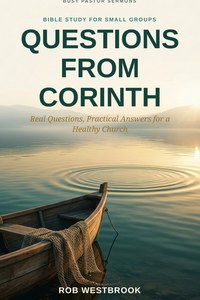
That's the idea behind my new Bible study, Questions from Corinth: Real Questions, Practical Answers for a Healthy Church. It's a 12-week small-group study written to go with my Questions from Corinth sermon series.
The sermons and the study share one set of passages. Lesson 1 uses the same Scripture as Sermon 1. Lesson 2 matches Sermon 2. And so on, all twelve weeks.
One series. Your whole church.
WHY CORINTH
Every church carries a stack of hard questions. Divisions that won't heal. Immorality that needs confronting. Gray areas that divide good people. Marriage. The gospel itself. A pastor carries the weight of answering them.
The church in Corinth carried that same stack. And Paul answered every question by pointing back to the gospel.
That's why 1 Corinthians works so well for a whole-church series. Your people already have these questions. Paul gives them real answers.
THE SERIES AND THE STUDY, WEEK BY WEEK
Here's how the twelve weeks line up, in the order the book follows:
- Reminders (1 Corinthians 1:1-9)
- What About Divisions in the Church? (1 Corinthians 1:10-11)
- Flee Immorality (1 Corinthians 6:13-20)
- What About the Lord's Supper? (1 Corinthians 11:17-30)
- Who's the Most Important? (1 Corinthians 12:12-27)
- What About Temptation? (1 Corinthians 10:6-13)
- What about Gray Areas? (1 Corinthians 8:1-13)
- Is Marriage Important? (1 Corinthians 7:1-16)
- The Do's and Don'ts of Love (1 Corinthians 13:4-8)
- What About the Cross? (1 Corinthians 1:17-25)
- What Is the Gospel? (1 Corinthians 15:1-4)
- What About the Resurrection? (1 Corinthians 15:12-19)
Notice the order. It follows the questions, not the chapters. Your church hears the practical ones first and ends where Paul ends up: the gospel and the resurrection.
HOW A WEEK WORKS
It's simple on purpose.
Sunday. You preach the sermon. Use the outline from the series, make it your own, and say the next week's title at the end.
During the week. Your groups meet and work through that week's lesson. Each session runs 60 minutes:
- Welcome and warm-up (10 minutes)
- Teaching recap (10 minutes)
- Discussion and application (35 minutes)
- Closing prayer (5 minutes)
Each lesson also gives your group a big idea, the full ESV text of the passage, discussion questions that move from understanding to application, and a short go-deeper note. And there's a share-nudge: one thing to tell someone outside the group.
Two of the questions in each lesson are "wrestle" questions. They don't have tidy answers. Some of the best moments in a small group come when nobody has the answer yet.
YOU DON'T HAVE TO BE A SEASONED LEADER
Here's the part I care about most.
Not everyone who leads a small group or a Sunday School class has done it before. So the back of the book has a leader's guide for every week. You get a session goal, prep notes, a timed agenda, alternate icebreakers, and a leader tip.
A volunteer can open it the night before and be ready. I wanted a leader who has never led a study to walk in with confidence.
PLAN THE CALENDAR AROUND IT
Twelve weeks is about a quarter of the year. That's long enough to go deep and short enough to finish.
Here's what I'd suggest (and this is only a suggestion): pick your start date, put all twelve Sundays on the calendar, then tell your small group leaders and Sunday School teachers the same day. Give them the study before the series starts so they have time to read ahead.
When the pulpit and the small groups work from one plan, the whole church can plan around it. That's what I mean by a whole-church experience.
TRY LESSON 1 FREE
You shouldn't have to take my word for it. I put the complete first lesson on the study's page, with its full leader's guide. Read it. Run it with a small group if you like. If it fits your church, the rest of the book is there.
The Bible study is in print on Amazon. You'll find the free first lesson and the week-by-week plan on the Questions from Corinth Bible study page. The sermon outlines are in Sermon Outlines for Busy Pastors: Questions from Corinth Sermon Series (also in Volume 4 and Sermon Series Box Set 2).